

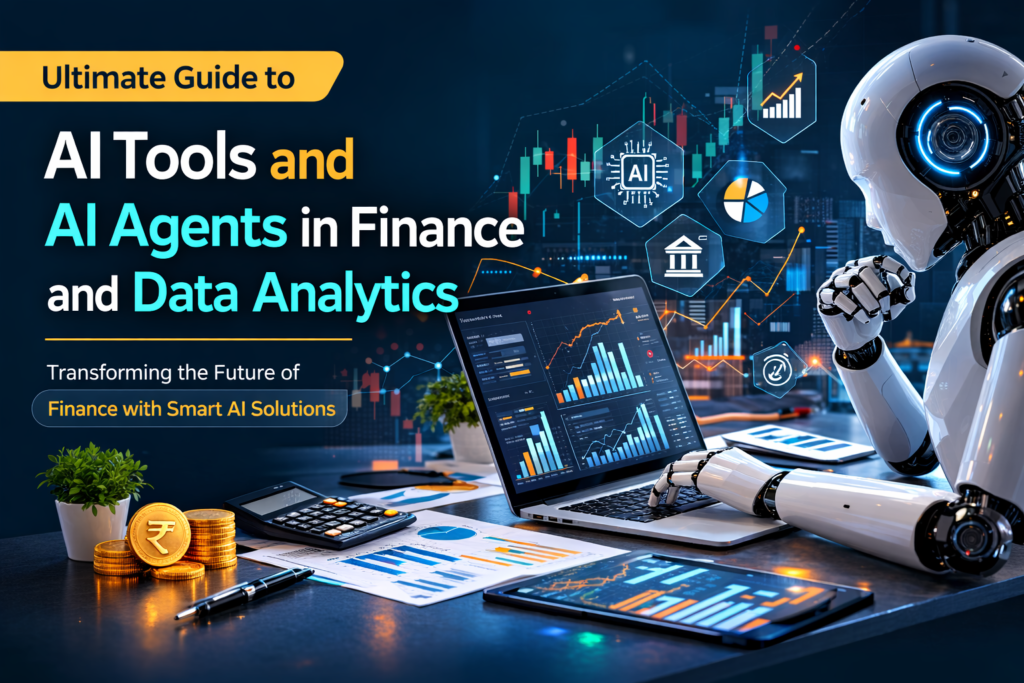
Artificial intelligence is rapidly transforming the finance and financial analytics industry. As a result, finance professionals must stay updated with modern AI tools that enhance data analysis, automate complex tasks, and improve decision-making.
This guide explores some of the leading AI tools and AI agents used in finance today. It also compares their key features, strengths, and limitations, helping professionals choose the right solutions for financial analysis, risk management, and business strategy.
ChatGPT (Enterprise and Advanced Data Analysis)
ChatGPT supports financial analysis, forecasting, and reporting. In fact, finance teams use it for decision support.
IBM Watson AI for Financial Services
IBM Watson AI supports regulated finance operations. Therefore, banks trust it for compliance analytics.
Google Cloud AI / Vertex AI
Vertex AI enables custom financial machine learning models. In addition, it handles large datasets efficiently.
AlphaSense
AlphaSense delivers AI-driven financial research insights. Consequently, analysts make faster investment decisions.
Zest AI
Zest AI improves credit underwriting accuracy. Therefore, lenders reduce risk and bias.
Feedzai
Feedzai detects fraud in real time. In fact, global banks rely on its AI models.
Forter
Forter protects digital payments using AI. Meanwhile, businesses improve approval rates.
Botkeeper
Botkeeper automates bookkeeping and reconciliations. Consequently, finance teams save time.
Tipalti
Tipalti automates accounts payable processes. In addition, it supports global tax compliance.
Ramp AI
Ramp AI acts as a finance operations agent. Finally, companies control spending proactively.
Frequently Asked Questions
1. What are AI tools in finance?
AI tools in finance are software platforms that use artificial intelligence to analyze financial data, automate processes, detect fraud, and support better decision-making. These tools help financial professionals manage large amounts of data quickly and accurately.
2. What are AI agents in financial analytics?
AI agents are intelligent systems that can perform tasks autonomously, such as monitoring financial transactions, generating reports, predicting trends, and providing insights for financial planning and risk management.
3. How are AI tools used in financial analytics?
AI tools are used for predictive analytics, risk assessment, algorithmic trading, fraud detection, and automated financial reporting. They help businesses analyze data patterns and make data-driven financial decisions.
4. What are the benefits of using AI in finance?
AI in finance improves efficiency, reduces human error, enhances fraud detection, speeds up data analysis, and helps organizations make smarter investment and business decisions.
5. Can AI replace financial analysts?
AI cannot completely replace financial analysts. Instead, it supports them by automating repetitive tasks and providing insights, allowing professionals to focus on strategic decision-making.
6. What skills are needed to work with AI in finance?
Key skills include data analysis, financial modeling, basic programming knowledge, understanding of machine learning concepts, and familiarity with financial analytics tools.