

Prompt Engineering: The Complete Beginner’s Guide (2026)
Artificial intelligence is no longer a buzzword. It’s in your phone, your browser, your workplace — and it’s changing how we work, create, and think. But here’s the thing: AI is only as powerful as the instructions you give it. That’s where prompt engineering comes in. Whether you’re a student, a freelancer, a developer, or a business owner, learning this skill could be one of the highest-leverage investments you make in 2026.
What Is Prompt Engineering?
Prompt engineering is the skill of crafting effective inputs — called prompts — to get the best possible outputs from AI language models like ChatGPT, Claude, Gemini, or Llama.
Think of it like giving instructions to a very intelligent assistant. The clearer and more structured your instructions are, the better the result you’ll get. Prompt engineering is the art and science of doing exactly that.
In simple terms: Prompt Engineering = Knowing how to talk to AI so it does exactly what you need.
Why Is Prompt Engineering Important in Today’s AI-Driven World?
We are living in the era of generative AI. Tools like ChatGPT, Claude, Midjourney, and GitHub Copilot are used by millions every day. But most users only scratch the surface of what these tools can do.
A well-engineered prompt can be the difference between a vague, generic response and a precise, actionable answer that saves you hours of work. As AI becomes more embedded in business, education, and daily life, prompt engineering has become a foundational digital literacy skill — much like knowing how to use a search engine was in the 2000s.
According to Anthropic’s official Prompt Engineering documentation, structuring your prompts correctly is the single most impactful step before considering any advanced technique like fine-tuning.
A Brief History of Prompt Engineering
From Early Chatbots to Modern LLMs
The concept of talking to machines has been around since the 1960s. Early programs like ELIZA (1966) used scripted rules to simulate conversation. They were impressive for their time, but rigid — they couldn’t understand context or nuance.
In the 1990s and 2000s, AI assistants like Siri, Cortana, and Alexa introduced voice-based prompting. But they, too, relied on narrow, pre-programmed responses. The real shift came with deep learning and the rise of transformer-based models.
The Rise of GPT and Generative AI
In 2017, Google introduced the Transformer architecture, which revolutionized how machines understand language. OpenAI’s GPT-3 (2020) was a watershed moment — suddenly, AI could generate coherent, contextual text from almost any instruction.
With GPT-3, researchers and developers began noticing something powerful: the way you phrased a question dramatically changed the quality of the answer. This observation sparked the formal study of prompt engineering as a discipline.
How User Input Evolved into Structured Prompting
Early AI users typed simple queries. As LLMs grew more capable, users discovered they could use roles, instructions, examples, and context to dramatically improve results. By 2023, with the mainstream launch of ChatGPT, prompt engineering had become a recognized discipline — and even a job title. Today, every major AI company — from OpenAI to Anthropic to Google — publishes official guides on prompt engineering best practices.
Why You Should Learn Prompt Engineering
Career Opportunities
Prompt engineering is one of the fastest-growing skills in tech. Companies across industries — from healthcare to marketing to finance — are hiring AI prompt engineers, AI trainers, and LLM specialists. Salaries for these roles can range from $80,000 to over $300,000 per year depending on experience and specialization.
The community-driven Prompt Engineering Guide by DAIR.AI — cited by Google and OpenAI — is one of the most comprehensive free resources to start your learning journey.
Use Cases Across Industries
- Content Creation: Write blogs, social media posts, ad copy, and scripts faster than ever.
- Coding: Generate, debug, and explain code in any programming language using tools like GitHub Copilot.
- Education: Create lesson plans, quizzes, explanations, and personalized tutoring content.
- Business Automation: Draft emails, summarize documents, analyze data, and generate reports.
- Customer Support: Build smarter chatbots and automated response systems.
- Research: Synthesize information, generate hypotheses, and summarize papers.
Who Benefits?
- Students: Get clearer explanations, study help, and writing assistance.
- Professionals: Speed up tasks, automate repetitive work, and generate better reports.
- Businesses: Scale content production, reduce costs, and improve customer experiences.
- Creators: Unlock new ideas, overcome creative blocks, and produce more in less time.
How LLMs Understand Prompts
To write great prompts, it helps to understand how Large Language Models (LLMs) process your input. Here are the key concepts:
Tokens
AI models don’t read words — they read tokens. A token is roughly 3–4 characters or about ¾ of a word. “Prompt engineering” = approximately 3 tokens. Models have a context window — a maximum number of tokens they can process at once. You can experiment with tokenization using OpenAI’s official Tokenizer tool.
Why it matters: Very long prompts may cut off important context. Keep your prompts focused and efficient.
Context
LLMs rely heavily on context — everything in the conversation up to that point. The more relevant context you provide, the better the model understands your intent.
Example: Instead of “Write a summary,” try “Write a 3-sentence summary of the following research paper for a non-technical audience:” — the added context changes everything.
Instructions
Instructions tell the model what to do, how to do it, and in what format. Think of them as a recipe — the more precise the instructions, the better the dish. Vague instructions produce vague results. OpenAI’s Prompt Engineering guide emphasizes that being specific about the desired output is the single most impactful prompt improvement you can make.
Temperature (Creativity vs. Accuracy)
Temperature is a setting that controls how creative or conservative the model’s responses are. A lower temperature (closer to 0) makes responses more predictable and factual. A higher temperature (closer to 1 or above) makes responses more creative and varied.
- Low Temperature: Best for factual answers, code, and legal text.
- High Temperature: Best for storytelling, brainstorming, and creative writing.
Best Practices for Writing Good Prompts
The following best practices are drawn from official documentation published by OpenAI, Anthropic, and Google Cloud.
1. Be Clear and Specific
Vague prompts produce vague results. Define exactly what you want, how long it should be, and what tone it should use.
❌ “Write about climate change.”
✅ “Write a 300-word blog introduction about the economic impact of climate change, targeting small business owners.”
2. Provide Context
Give the AI background information relevant to your task. The more it knows about your situation, the more tailored the output will be. Think of it as briefing a new colleague — the more context you share, the better they can help.
3. Use Role-Based Prompting
Assign the AI a role to frame its responses. This dramatically changes the style and depth of the output.
Example: “You are an expert nutritionist. Explain the benefits of intermittent fasting for someone with Type 2 diabetes.”
4. Use Examples (Few-Shot Prompting)
Show the AI what you want by giving it one or more examples before your actual request. This is called few-shot prompting and is one of the most effective techniques available. According to Anthropic’s prompt engineering documentation, using examples is often more effective than longer instructions alone.
5. Break Complex Tasks Into Steps
Don’t dump a multi-part task into one prompt. Guide the model step by step, especially for complex projects. This reduces errors and improves output quality significantly.
6. Specify the Output Format
Tell the AI exactly how you want the response formatted — bullet points, a table, JSON, a numbered list, a paragraph, etc.
Example: “Respond in a numbered list with each item no longer than two sentences.”
Examples of Good vs. Bad Prompts
Here’s a comparison table to show you exactly what makes a prompt effective:
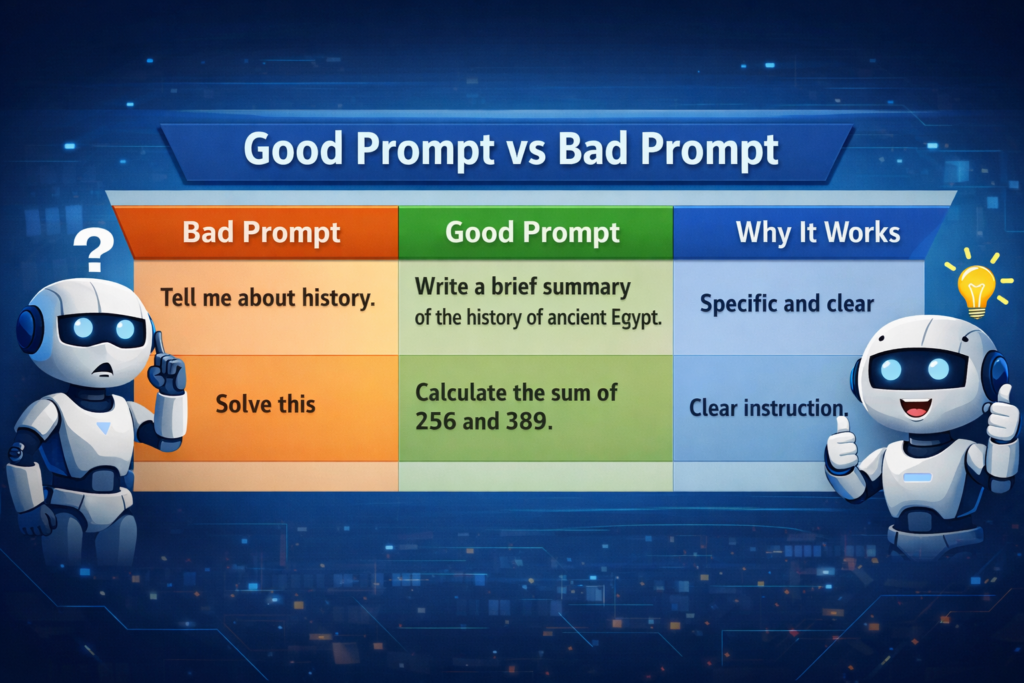
| Bad Prompt | Good Prompt | Why It Works |
|---|---|---|
| Write an email. | Write a professional follow-up email to a client who hasn’t responded in 5 days. Keep it friendly, under 100 words, and include a call to action. | Specifies tone, audience, word limit, and purpose. |
| Explain AI. | Explain artificial intelligence in simple terms for a 12-year-old, using a real-world analogy. | Defines the audience, complexity level, and format style. |
| Fix my code. | I’m writing Python. The following function should return the sum of a list, but it throws a TypeError. Here’s the code: [code]. Identify the bug and explain how to fix it. | Provides language, expected behavior, and actual code to analyze. |
| Write a blog post. | Write a 600-word SEO blog post on “benefits of drinking green tea” for a health and wellness website. Use H2 headings, a conversational tone, and include a short conclusion. | Specifies length, topic, platform, structure, and tone. |
| Give me marketing ideas. | I run a small handmade soap business targeting women aged 25–45. Suggest 5 creative Instagram content ideas for the holiday season, each with a caption example. | Defines business, audience, platform, season, and expected output format. |
Common Prompt Engineering Mistakes to Avoid
- Being too vague: “Write something about finance” will get you a generic, unfocused response. Always define the topic, audience, and goal.
- Overloading the prompt: Packing 10 different tasks into one prompt confuses the model. Break it into smaller, focused requests.
- Ignoring output format: If you need a table, say so. If you want bullet points, ask for them. Never assume the AI will guess your preferred format.
- Not iterating: Your first prompt rarely produces the perfect output. Refine, adjust, and experiment — iteration is part of the process.
- Skipping examples: When the task is complex or stylistic, examples make a massive difference. Don’t skip them.
- Forgetting to set the role: A prompt without a role context can produce generic answers. Assigning a role sharpens the response significantly.
Advanced Prompt Engineering Techniques
Chain-of-Thought Prompting
Chain-of-thought (CoT) prompting encourages the AI to think step by step before arriving at an answer. This is especially powerful for reasoning-heavy tasks like math problems, logic puzzles, or complex analysis.
Example: “Think step by step. A store sells 3 apples for $1.50. How much do 7 apples cost?”
This technique was formally studied in the landmark Chain-of-Thought Prompting research paper (Wei et al., 2022) published on arXiv. The research demonstrated that asking models to reason step by step significantly improves performance on complex arithmetic, commonsense, and symbolic reasoning tasks.
Role Prompting
Role prompting gives the AI a persona or expert identity. It frames the model’s responses within a specific mindset, which leads to more relevant, authoritative answers.
- “Act as a senior software engineer with 10 years of experience in Python.”
- “You are a compassionate therapist. A client says they feel overwhelmed. How do you respond?”
- “You are a Michelin-star chef. Suggest a 3-course dinner menu using only seasonal autumn ingredients.”
Zero-Shot vs. Few-Shot Prompting
These terms describe how many examples you provide in your prompt:
- Zero-shot: No examples given. You just describe the task. Works well for simple, well-understood requests. Example: “Translate ‘Good morning’ into French.”
- One-shot: You provide one example before the task. Helps the model understand your desired style or format.
- Few-shot: You provide 2–5 examples. This is the most powerful approach for tasks requiring a specific output style, tone, or structure.
Few-shot example:
Classify the following customer reviews as Positive, Neutral, or Negative.
Review: “The product arrived on time and works great!” → Positive
Review: “It’s okay, nothing special.” → Neutral
Review: “Completely broke after one use. Very disappointed.” → Negative
Now classify this: “Honestly surprised by how well it works for the price.”
Official Resources to Deepen Your Learning
Here are the most authoritative, official resources available today — all free:
- 🔵 OpenAI: Official Prompt Engineering Guide — Covers structure, formatting, and GPT-4 specific strategies.
- 🟠 Anthropic (Claude): Prompt Engineering Overview — Covers clarity, XML tags, and Claude-specific best practices.
- 🟠 Anthropic Interactive Tutorial: 9-Chapter Hands-On Course on GitHub — Practice prompting in real time with Claude.
- 🔴 Google Cloud: Vertex AI Prompt Engineering Best Practices — Enterprise-focused guide for Gemini and Vertex AI.
- 🟢 DAIR.AI: The Prompt Engineering Guide — Community-maintained, cited by Google and OpenAI. Covers everything from basics to advanced agent architectures.
- 🔬 Research Paper: Chain-of-Thought Prompting Elicits Reasoning in LLMs (Wei et al., 2022) — The foundational research behind one of the most powerful prompting techniques.
Conclusion: Start Prompting Smarter Today
Prompt engineering is not just a technical skill reserved for developers or data scientists. It’s a human communication skill — the ability to express your intent clearly and get powerful results from AI tools.
Here’s what to remember:
- Be specific, not vague.
- Provide context and set a role.
- Use examples when the task is complex.
- Specify your desired output format.
- Iterate — your best prompt is rarely your first.
- Explore advanced techniques like chain-of-thought and few-shot prompting.
The AI revolution is here. And the people who know how to communicate with AI effectively will have a massive advantage — in their careers, in their businesses, and in their daily lives.
So open up ChatGPT, Claude, or your favorite AI tool right now. Try rewriting one of your old prompts using what you’ve learned here. You might be amazed at the difference.
Frequently Asked Questions (FAQs)
1. What exactly is prompt engineering?
Prompt engineering is the practice of crafting structured, precise inputs to guide AI language models like ChatGPT or Claude toward producing accurate, relevant, and high-quality outputs. It involves understanding how AI processes language and using that knowledge to communicate more effectively with AI systems. You can read the official definition from Anthropic’s documentation here.
2. Is prompt engineering a good career choice in 2026?
Yes — absolutely. As AI adoption grows across every industry, the demand for people who can work effectively with AI systems is skyrocketing. Prompt engineers, AI trainers, and LLM specialists are among the most in-demand tech roles today. Many companies — from startups to Fortune 500s — are actively hiring for these positions with competitive salaries.
3. Do I need coding skills to learn prompt engineering?
No — not for most use cases. Prompt engineering for everyday tools like ChatGPT, Claude, or Gemini requires no coding at all. However, if you want to integrate prompts into software applications or work with the AI API, some basic knowledge of Python or JavaScript is helpful. For most business, creative, and educational use cases, natural language skills are all you need.
4. How can I practice prompt engineering?
The best way to improve is to practice consistently. Here’s how to start:
- Pick a free AI tool — ChatGPT, Claude, or Google Gemini.
- Choose a real task you want help with — writing, coding, research, or brainstorming.
- Write your first prompt, review the output, and iterate.
- Try adding roles, examples, and specific formatting requests.
- Work through Anthropic’s free Interactive Prompt Engineering Tutorial on GitHub.
- Keep a “prompt journal” — save prompts that work well for future use.
5. Which tools can I use to practice prompt engineering?
- ChatGPT (OpenAI) — The most widely used AI chat tool; great for general prompting practice.
- Claude (Anthropic) — Known for nuanced, thoughtful responses and handling long documents.
- Google Gemini — Integrated with Google Workspace; great for productivity tasks.
- Perplexity AI — Excellent for research-oriented prompts with source citations.
- PromptBase — A marketplace to buy, sell, and discover high-performing prompts.
- DAIR.AI Prompting Guide — Free, open-source guide with interactive examples for all levels.
- GitHub Copilot — Ideal for coding-focused prompt engineering inside your development environment.
6. What is the difference between zero-shot and few-shot prompting?
Zero-shot prompting means you give the AI a task without any examples — just a clear instruction. Few-shot prompting means you include one or more examples in your prompt to show the AI exactly what kind of output you expect. Few-shot prompting generally produces more consistent, higher-quality results for complex or stylistic tasks. This distinction was a core finding in the Chain-of-Thought Prompting paper (Wei et al., 2022).
7. Can prompt engineering be used for image generation AI too?
Absolutely. Prompt engineering applies to image-generation tools like DALL-E 3, Midjourney, and Stable Diffusion, not just text-based AI. For image prompts, be specific about style, lighting, composition, subject, and mood. For example, instead of “a sunset,” try “a photorealistic golden hour sunset over a calm ocean, viewed from a beach, soft warm tones, high resolution.” The specificity transforms the output dramatically.
Did you find this guide helpful? Share it with someone who’s just getting started with AI — and drop your questions in the comments below. Happy prompting! 🚀
Visit Our Other Blogs on AI
The Last 20 Years of Artificial Intelligence: AI Journey of Innovation and Evolution
Ultimate Best AI Tools for Financial Analysts in 2026
The Ultimate AI Tools Guide for 2026: ChatGPT, Gemini, and Claude Compared
Powerful AI Tools Revolutionizing Medical Imaging & Radiology