Core Artificial Intelligence Technologies Explained
Artificial Intelligence includes different technologies that solve specific problems. In fact, each technology focuses on a unique capability. However, many AI systems combine multiple technologies. Therefore, understanding the differences is important. Furthermore, these technologies support real-world applications. In addition, they improve automation and efficiency. Finally, they help humans work smarter.
Machine Learning (ML)
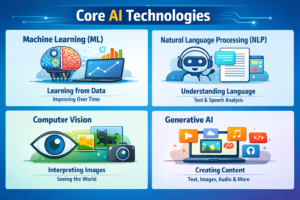
Machine Learning allows systems to learn from data automatically. In fact, ML improves performance without manual programming. However, it depends on quality data. Therefore, better data leads to better results. Furthermore, ML identifies patterns and trends. In addition, it supports predictions and recommendations. Finally, ML improves accuracy over time.
Natural Language Processing (NLP)
Natural Language Processing helps computers understand human language. In fact, NLP processes text and speech. However, language complexity creates challenges. Therefore, NLP models analyze grammar and meaning. Furthermore, NLP enables chatbots and translators. In addition, it supports sentiment analysis. Finally, NLP improves human-computer interaction.
Computer Vision
Computer Vision allows machines to interpret images and videos. In fact, it mimics human visual understanding. However, image quality affects results. Therefore, models require proper training. Furthermore, Computer Vision detects objects and faces. In addition, it analyzes video content. Finally, it supports automation and safety systems.
Generative AI

Generative AI creates new content using learned patterns. In fact, it produces text, images, audio, and videos. However, it does not truly understand content. Therefore, users must guide outputs carefully. Furthermore, Generative AI boosts creativity. In addition, it speeds up content creation. Finally, it supports innovation across industries.
Comparison of Core AI Technologies
| AI Technology | What It Does | Common Examples | Real-Life Use Cases |
|---|---|---|---|
| Machine Learning (ML) | Learns from data and improves performance | Recommendations, predictions | Sales forecasting, fraud detection |
| Natural Language Processing (NLP) | Understands and generates language | Chatbots, translators | Customer support, email automation |
| Computer Vision | Interprets images and videos | Face recognition, object detection | Security systems, medical imaging |
| Generative AI | Creates new content | Text, image, and video generation | Marketing content, training materials |
Frequently Asked Questions
What is the difference between ML and Generative AI?
Machine Learning analyzes data to make predictions. However, Generative AI creates new content.
Is NLP part of Machine Learning?
Yes, NLP often uses Machine Learning models. In fact, ML helps NLP improve accuracy.
Where is Computer Vision commonly used?
Computer Vision is used in security, healthcare, and manufacturing. In addition, it supports automation.
Can Generative AI replace human creativity?
No, Generative AI supports creativity. However, humans guide ideas and decisions.
Do these AI technologies work together?
Yes, many AI systems combine ML, NLP, and Computer Vision. Therefore, results improve.
Which AI technology should beginners learn first?
Beginners should start with Generative AI tools. In fact, they offer quick, practical benefits.
Visit Our Other blogs on AI and AI tools
Mindtrip AI: Smart AI Trip Planning Made Simple
Microsoft 365 Copilot: AI Assistant for Modern Work