The Japanese N5 Exam is the entry-level stage of the Japanese Language Proficiency Test. also, Japanese is not capitalized mid-sentence. At this stage, students focus on fundamental vocabulary commonly used in daily life. Specifically, this encompasses greetings, numbers, colors, food items, family-related terms, days of the week, time expressions, and basic emotions. As a result, mastering these simple words enables beginners to grasp everyday conversations and lays a solid groundwork for confidently speaking Japanese.
The Japanese language is among the most intriguing languages globally. It embodies the culture, respect, and traditions of Japan. Even mastering a handful of basic Japanese words can enhance your understanding of japanese culture and improve your communication with people in Japan. Mastering these simple words is the first step to clearing the Japanese N5 Exam with confidence.
Why Prepare for Japanese N5 Exam ?
First of all, studying Japanese provides access to Japan’s vibrant culture, traditions, and contemporary advancements. In particular, it enables you to connect with Japanese individuals and delve into their distinctive lifestyle. For instance, numerous individuals take up Japanese to fully appreciate anime, manga, Japanese films, and music in their authentic form. Moreover, it enhances the experience of traveling to Japan, making it more enriching.
Beyond cultural benefits, Japanese is advantageous for career prospects, particularly in sectors such as technology, business, tourism, and international relations, given the global influence of Japanese companies. Ultimately, learning Japanese transcends mere language acquisition — it’s about uncovering a captivating culture and broadening international opportunities.
How this Japanese N5 Exam Word List Helps Beginners
To begin with, this list of words is great for beginners to pick up essential Japanese vocabulary that comes in handy every day, like greetings, numbers, colors, food, family, days & time, and feelings. Furthermore, it lays a solid groundwork for those getting ready for the N5 level of the Japanese Language Proficiency Test and therefore boosts their confidence in starting to understand and speak basic Japanese.
How to Use This Japanese N5 Exam Vocabulary Guide
To get started, go through each section such as greetings, numbers, colors, food, family, days & time, and feelings. Next, make it a habit to practice the words every day and attempt to use them in straightforward sentences. In addition, try writing simple phrases using the words you learn. In this way, beginners will gradually expand their vocabulary and get ready for the Japanese Language Proficiency Test N5 level.
Three Writing Systems Used in the Japanese N5 Exam

The Japanese language employs three distinct writing systems. First, Hiragana (ひらがな) is used for fundamental words and grammar. Second, Katakana (カタカナ) is used for foreign terms and names, emphasis, scientific terms, and onomatopoeia. Finally, Kanji (漢字) are Chinese characters that convey meanings and concepts. As a result, for beginners, mastering Hiragana is typically the initial step.
As a result, for beginners, mastering Hiragana is typically the initial step.
Japanese N5 Exam Greetings Vocabulary
| Japanese | Hiragana | Pronunciation | Meaning |
|---|---|---|---|
| こんにちは | こんにちは | Konnichiwa | Hello / Good afternoon |
| おはようございます | おはようございます | Ohayou Gozaimasu | Good morning |
| こんばんは | こんばんは | Konbanwa | Good evening |
| ありがとう | ありがとう | Arigatou | Thank you |
| ありがとうございます | ありがとうございます | Arigatou Gozaimasu | Thank you very much |
| すみません | すみません | Sumimasen | Excuse me / Sorry |
| ごめんなさい | ごめんなさい | Gomennasai | I’m sorry |
| さようなら | さようなら | Sayounara | Goodbye |
| はじめまして | はじめまして | Hajimemashite | Nice to meet you |
| よろしくおねがいします | よろしくおねがいします | Yoroshiku Onegaishimasu | Please take care of me |
| おやすみなさい | おやすみなさい | Oyasuminasai | Good night |
| いってきます | いってきます | Ittekimasu | I’m leaving |
| いってらっしゃい | いってらっしゃい | Itterasshai | Take care / See you later |
| ただいま | ただいま | Tadaima | I’m home |
| おかえりなさい | おかえりなさい | Okaerinasai | Welcome back |
| いただきます | いただきます | Itadakimasu | Let’s eat (before meal) |
| ごちそうさまでした | ごちそうさまでした | Gochisousamadeshita | Thank you for the meal |
Japanese N5 Exam Family Words
| Japanese | Hiragana | Pronunciation | Polite Form (Their family) | Meaning |
|---|---|---|---|---|
| 家族 | かぞく | Kazoku | Gokazoku (ご家族) | Family |
| 父 | ちち | Chichi | Otōsan (お父さん) | Father (own) |
| 母 | はは | Haha | Okāsan (お母さん) | Mother (own) |
| 両親 | りょうしん | Ryoushin | Goryōshin (ご両親) | Parents |
| 兄 | あに | Ani | Oniisan (お兄さん) | Older brother (own) |
| 姉 | あね | Ane | Onēsan (お姉さん) | Older sister (own) |
| 弟 | おとうと | Otouto | Otōtosan (弟さん) | Younger brother |
| 妹 | いもうと | Imouto | Imōtosan (妹さん) | Younger sister |
| 祖父 | そふ | Sofu | Ojīsan (お祖父さん) | Grandfather |
| 祖母 | そぼ | Sobo | Obāsan (お祖母さん) | Grandmother |
| 子供 | こども | Kodomo | Child | |
| 息子 | むすこ | Musuko | Son | |
| 娘 | むすめ | Musume | Daughter | |
| 夫 | おっと | Otto | Husband | |
| 妻 | つま | Tsuma | Wife | |
| おとうさん | おとうさん | Otousan | Father (someone else’s) | |
| おかあさん | おかあさん | Okaasan | Mother (someone else’s) | |
| おにいさん | おにいさん | Oniisan | Older brother (someone else’s) | |
| おねえさん | おねえさん | Oneesan | Older sister (someone else’s) |
Japanese N5 Exam Numbers Vocabulary
| Japanese | Hiragana | Pronunciation | Meaning |
|---|---|---|---|
| 零/ゼロ | れい/ぜろ | Rei / Zero | Zero |
| 一 | いち | Ichi | One |
| 二 | に | Ni | Two |
| 三 | さん | San | Three |
| 四 | よん/し | Yon / Shi | Four |
| 五 | ご | Go | Five |
| 六 | ろく | Roku | Six |
| 七 | なな/しち | Nana / Shichi | Seven |
| 八 | はち | Hachi | Eight |
| 九 | く/きゅう | Ku / Kyuu | Nine |
| 十 | じゅう | Juu | Ten |
| 十一 | じゅういち | Juuichi | Eleven |
| 二十 | にじゅう | Nijuu | Twenty |
| 百 | ひゃく | Hyaku | Hundred |
| 千 | せん | Sen | Thousand |
| 万 | まん | Man | Ten thousand |
| 一つ | ひとつ | Hitotsu | One (counting things) |
| 二つ | ふたつ | Futatsu | Two (counting things) |
| 三つ | みっつ | Mittsu | Three (counting things) |
| 四つ | よっつ | Yottsu | Four (counting things) |
Japanese N5 Exam Food and Drink Words
| Japanese | Hiragana | Pronunciation | Meaning |
|---|---|---|---|
| 食べ物 | たべもの | Tabemono | Food |
| 水 | みず | Mizu | Water |
| お茶 | おちゃ | Ocha | Tea |
| ご飯 | ごはん | Gohan | Rice / Meal |
| パン | ぱん | Pan | Bread |
| 魚 | さかな | Sakana | Fish |
| 肉 | にく | Niku | Meat |
| 野菜 | やさい | Yasai | Vegetables |
| 果物 | くだもの | Kudamono | Fruits |
| 牛乳 | ぎゅうにゅう | Gyuunyuu | Milk |
| 卵 | たまご | Tamago | Egg |
| 鶏肉 | とりにく | Toriniku | Chicken |
| 豚肉 | ぶたにく | Butaniku | Pork |
| 牛肉 | ぎゅうにく | Gyuuniku | Beef |
| りんご | りんご | Ringo | Apple |
| みかん | みかん | Mikan | Mandarin orange |
| バナナ | ばなな | Banana | Banana |
| 塩 | しお | Shio | Salt |
| 砂糖 | さとう | Satou | Sugar |
| 醤油 | しょうゆ | Shouyu | Soy sauce |
| コーヒー | こーひー | Koohii | Coffee |
| ジュース | じゅーす | Juusu | Juice |
| ビール | びーる | Biiru | Beer |
| 酒 | さけ | Sake | Sake / Alcohol |
Japanese N5 Exam Days and Time Vocabulary
| Japanese | Hiragana | Pronunciation | Meaning |
|---|---|---|---|
| 今日 | きょう | Kyou | Today |
| 明日 | あした | Ashita | Tomorrow |
| 昨日 | きのう | Kinou | Yesterday |
| 月曜日 | げつようび | Getsuyoubi | Monday |
| 火曜日 | かようび | Kayoubi | Tuesday |
| 水曜日 | すいようび | Suiyoubi | Wednesday |
| 木曜日 | もくようび | Mokuyoubi | Thursday |
| 金曜日 | きんようび | Kinyoubi | Friday |
| 土曜日 | どようび | Doyoubi | Saturday |
| 日曜日 | にちようび | Nichiyoubi | Sunday |
| 時間 | じかん | Jikan | Time |
| 今 | いま | Ima | Now |
| 朝 | あさ | Asa | Morning |
| 昼 | ひる | Hiru | Noon / Daytime |
| 夜 | よる | Yoru | Night |
| 週 | しゅう | Shuu | Week |
| 月 | つき/がつ | Tsuki / Gatsu | Month / Moon |
| 年 | とし/ねん | Toshi / Nen | Year |
| 先週 | せんしゅう | Senshuu | Last week |
| 来週 | らいしゅう | Raishuu | Next week |
| 今週 | こんしゅう | Konshuu | This week |
| 去年 | きょねん | Kyonen | Last year |
| 来年 | らいねん | Rainen | Next year |
| 今年 | ことし | Kotoshi | This year |
| 一月 | いちがつ | Ichigatsu | January |
| 二月 | にがつ | Nigatsu | February |
| 三月 | さんがつ | Sangatsu | March |
| 四月 | しがつ | Shigatsu | April |
| 五月 | ごがつ | Gogatsu | May |
| 六月 | ろくがつ | Rokugatsu | June |
| 七月 | しちがつ | Shichigatsu | July |
| 八月 | はちがつ | Hachigatsu | August |
| 九月 | くがつ | Kugatsu | September |
| 十月 | じゅうがつ | Juugatsu | October |
| 十一月 | じゅういちがつ | Juuichigatsu | November |
| 十二月 | じゅうにがつ | Juunigatsu | December |
School & Stationery
| Japanese | Hiragana | Pronunciation | Meaning |
|---|---|---|---|
| 学校 | がっこう | Gakkou | School |
| 先生 | せんせい | Sensei | Teacher |
| 生徒 | せいと | Seito | Student |
| 教室 | きょうしつ | Kyoushitsu | Classroom |
| 本 | ほん | Hon | Book |
| ノート | のーと | Nooto | Notebook |
| 鉛筆 | えんぴつ | Enpitsu | Pencil |
| ペン | ぺん | Pen | Pen |
| 消しゴム | けしごむ | Keshigomu | Eraser |
| 机 | つくえ | Tsukue | Desk |
| 椅子 | いす | Isu | Chair |
| 黒板 | こくばん | Kokuban | Blackboard |
| 辞書 | じしょ | Jisho | Dictionary |
| 問題 | もんだい | Mondai | Question / Problem |
| 答え | こたえ | Kotae | Answer |
| 試験 | しけん | Shiken | Exam / Test |
Japanese N5 Exam Emotions Vocabulary
| Japanese | Hiragana | Pronunciation | Meaning |
|---|---|---|---|
| 嬉しい | うれしい | Ureshii | Happy |
| 悲しい | かなしい | Kanashii | Sad |
| 怒る | おこる | Okoru | To get angry |
| 楽しい | たのしい | Tanoshii | Fun / Enjoyable |
| 驚く | おどろく | Odoroku | To be surprised |
| 怖い | こわい | Kowai | Scared |
| 大好き | だいすき | Daisuki | Really like |
| 嫌い | きらい | Kirai | Dislike |
| 心配 | しんぱい | Shinpai | Worried |
| 疲れた | つかれた | Tsukareta | Tired |
| 恥ずかしい | はずかしい | Hazukashii | Embarrassed |
| 寂しい | さびしい | Sabishii | Lonely |
| 眠い | ねむい | Nemui | Sleepy |
| 痛い | いたい | Itai | Painful |
| 大丈夫 | だいじょうぶ | Daijoubu | Okay / All right |
| 好き | すき | Suki | Like |
| 嫌 | いや | Iya | Unpleasant / No |
Japanese N5 Exam Travel Vocabulary
| Japanese | Hiragana | Pronunciation | Meaning |
|---|---|---|---|
| 旅行 | りょこう | Ryokou | Travel / Trip |
| 空港 | くうこう | Kuukou | Airport |
| 駅 | えき | Eki | Train station |
| 電車 | でんしゃ | Densha | Train |
| バス | ばす | Basu | Bus |
| 切符 | きっぷ | Kippu | Ticket |
| 地図 | ちず | Chizu | Map |
| ホテル | ほてる | Hoteru | Hotel |
| 入口 | いりぐち | Iriguchi | Entrance |
| 出口 | でぐち | Deguchi | Exit |
| 道 | みち | Michi | Road / Way |
| 左 | ひだり | Hidari | Left |
| 右 | みぎ | Migi | Right |
| まっすぐ | まっすぐ | Massugu | Straight ahead |
| 近い | ちかい | Chikai | Near |
| 遠い | とおい | Tooi | Far |
| タクシー | たくしー | Takushii | Taxi |
| 飛行機 | ひこうき | Hikouki | Airplane |
| 船 | ふね | Fune | Ship / Boat |
| 自転車 | じてんしゃ | Jitensha | Bicycle |
| 車 | くるま | Kuruma | Car |
Clothing
| Japanese | Hiragana | Pronunciation | Meaning |
|---|---|---|---|
| 服 | ふく | Fuku | Clothes |
| シャツ | しゃつ | Shatsu | Shirt |
| ズボン | ずぼん | Zubon | Trousers |
| スカート | すかーと | Sukaato | Skirt |
| 靴 | くつ | Kutsu | Shoes |
| 靴下 | くつした | Kutsushita | Socks |
| 帽子 | ぼうし | Boushi | Hat / Cap |
| コート | こーと | Kooto | Coat |
| 眼鏡 | めがね | Megane | Glasses |
| かばん | かばん | Kaban | Bag |
Japanese N5 Exam Colors Vocabulary
| Japanese | Hiragana | Pronunciation | Meaning |
|---|---|---|---|
| 赤 | あか | Aka | Red |
| 青 | あお | Ao | Blue / Green (in some contexts) |
| 黄色 | きいろ | Kiiro | Yellow |
| 緑 | みどり | Midori | Green |
| 黒 | くろ | Kuro | Black |
| 白 | しろ | Shiro | White |
| 茶色 | ちゃいろ | Chairo | Brown |
| ピンク | ぴんく | Pinku | Pink |
| 紫 | むらさき | Murasaki | Purple |
| 灰色 | はいいろ | Haiiro | Gray |
| 橙色 | だいだいいろ | Daidaiiro | Orange |
| 金色 | きんいろ | Kin’iro | Gold |
| 銀色 | ぎんいろ | Gin’iro | Silver |
Body Parts
| Japanese | Hiragana | Pronunciation | Meaning |
|---|---|---|---|
| 体 | からだ | Karada | Body |
| 頭 | あたま | Atama | Head |
| 顔 | かお | Kao | Face |
| 目 | め | Me | Eye |
| 耳 | みみ | Mimi | Ear |
| 鼻 | はな | Hana | Nose |
| 口 | くち | Kuchi | Mouth |
| 手 | て | Te | Hand |
| 足 | あし | Ashi | Foot / Leg |
| 背中 | せなか | Senaka | Back |
| 腹 | おなか | Onaka | Stomach |
| 歯 | は | Ha | Tooth |
| 髪 | かみ | Kami | Hair |
| 指 | ゆび | Yubi | Finger |
Animals
| Japanese | Hiragana | Pronunciation | Meaning |
|---|---|---|---|
| 動物 | どうぶつ | Doubutsu | Animal |
| 犬 | いぬ | Inu | Dog |
| 猫 | ねこ | Neko | Cat |
| 魚 | さかな | Sakana | Fish |
| 鳥 | とり | Tori | Bird |
| 馬 | うま | Uma | Horse |
| 牛 | うし | Ushi | Cow |
| 豚 | ぶた | Buta | Pig |
| うさぎ | うさぎ | Usagi | Rabbit |
| くま | くま | Kuma | Bear |
| さる | さる | Saru | Monkey |
| へび | へび | Hebi | Snake |
Places & Locations
| Japanese | Hiragana | Pronunciation | Meaning |
|---|---|---|---|
| 学校 | がっこう | Gakkou | School |
| 病院 | びょういん | Byouin | Hospital |
| 銀行 | ぎんこう | Ginkou | Bank |
| 郵便局 | ゆうびんきょく | Yuubinkyoku | Post office |
| 図書館 | としょかん | Toshokan | Library |
| 公園 | こうえん | Kouen | Park |
| 店 | みせ | Mise | Shop / Store |
| スーパー | すーぱー | Suupaa | Supermarket |
| レストラン | れすとらん | Resutoran | Restaurant |
| 家 | いえ/うち | Ie / Uchi | House / Home |
| 部屋 | へや | Heya | Room |
| トイレ | といれ | Toire | Toilet |
| 会社 | かいしゃ | Kaisha | Company / Office |
| 町 | まち | Machi | Town |
| 山 | やま | Yama | Mountain |
| 川 | かわ | Kawa | River |
| 海 | うみ | Umi | Sea / Ocean |
Adjectives
| Japanese | Hiragana | Pronunciation | Meaning |
|---|---|---|---|
| 大きい | おおきい | Ookii | Big |
| 小さい | ちいさい | Chiisai | Small |
| 長い | ながい | Nagai | Long |
| 短い | みじかい | Mijikai | Short |
| 高い | たかい | Takai | Tall / Expensive |
| 低い | ひくい | Hikui | Low / Short (height) |
| 安い | やすい | Yasui | Cheap |
| 新しい | あたらしい | Atarashii | New |
| 古い | ふるい | Furui | Old |
| 速い | はやい | Hayai | Fast |
| 遅い | おそい | Osoi | Slow |
| 暑い | あつい | Atsui | Hot (weather) |
| 寒い | さむい | Samui | Cold (weather) |
| 熱い | あつい | Atsui | Hot (object) |
| 冷たい | つめたい | Tsumetai | Cold (object) |
| 良い | よい/いい | Yoi / Ii | Good |
| 悪い | わるい | Warui | Bad |
| 難しい | むずかしい | Muzukashii | Difficult |
| 易しい | やさしい | Yasashii | Easy |
| 面白い | おもしろい | Omoshiroi | Interesting / Funny |
| つまらない | つまらない | Tsumaranai | Boring |
| かわいい | かわいい | Kawaii | Cute |
| きれい | きれい | Kirei | Beautiful / Clean |
Verbs
| Japanese | Hiragana | Pronunciation | Meaning |
|---|---|---|---|
| 食べる | たべる | Taberu | To eat |
| 飲む | のむ | Nomu | To drink |
| 行く | いく | Iku | To go |
| 来る | くる | Kuru | To come |
| 帰る | かえる | Kaeru | To return home |
| 見る | みる | Miru | To see / watch |
| 聞く | きく | Kiku | To listen / ask |
| 話す | はなす | Hanasu | To speak |
| 読む | よむ | Yomu | To read |
| 書く | かく | Kaku | To write |
| 買う | かう | Kau | To buy |
| 売る | うる | Uru | To sell |
| 起きる | おきる | Okiru | To wake up |
| 寝る | ねる | Neru | To sleep |
| 座る | すわる | Suwaru | To sit |
| 立つ | たつ | Tatsu | To stand |
| 走る | はしる | Hashiru | To run |
| 歩く | あるく | Aruku | To walk |
| 働く | はたらく | Hataraku | To work |
| 勉強する | べんきょうする | Benkyou suru | To study |
| 遊ぶ | あそぶ | Asobu | To play |
| 会う | あう | Au | To meet |
| 使う | つかう | Tsukau | To use |
| 開ける | あける | Akeru | To open |
| 閉める | しめる | Shimeru | To close |
Weather
| Japanese | Hiragana | Pronunciation | Meaning |
|---|---|---|---|
| 天気 | てんき | Tenki | Weather |
| 晴れ | はれ | Hare | Sunny |
| 曇り | くもり | Kumori | Cloudy |
| 雨 | あめ | Ame | Rain |
| 雪 | ゆき | Yuki | Snow |
| 風 | かぜ | Kaze | Wind |
| 台風 | たいふう | Taifuu | Typhoon |
| 暑い | あつい | Atsui | Hot |
| 寒い | さむい | Samui | Cold |
| 涼しい | すずしい | Suzushii | Cool |
| 暖かい | あたたかい | Atatakai | Warm |
Practice Tips to Pass the Japanese N5 Exam
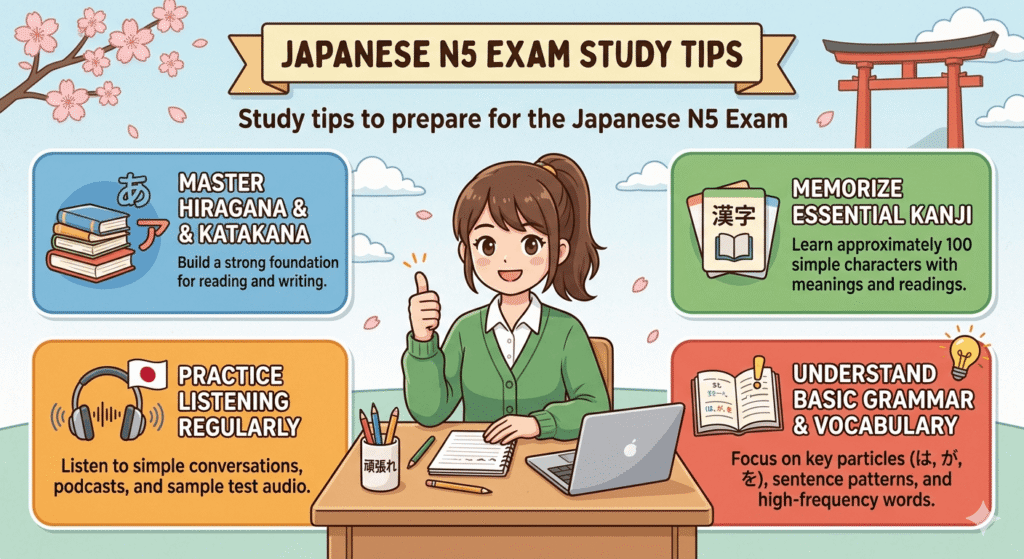
Following these tips consistently will get you exam-ready for the Japanese N5 Exam in no time
- First, practice every day — try to learn a handful of new words daily.
- In addition, utilize flashcards — they assist in memorizing vocabulary more quickly.
- Furthermore, speak aloud — work on your pronunciation to enhance your speaking abilities.
- For example, watch Japanese media — anime, films, or videos can expose you to authentic conversations.
- Finally, review frequently — go over the words often to retain them more effectively.
Frequently Asked Questions (FAQ)
What is the JLPT N5 exam?
The Japanese N5 exam is the beginner level of the Japanese Language Proficiency Test. It tests basic understanding of simple Japanese, including vocabulary, grammar, and reading.
How long does it take to prepare for JLPT N5?
It usually takes 2 to 3 months of consistent study for beginners to prepare for JLPT N5.
Is JLPT N5 difficult for beginners?
No, JLPT N5 is designed for beginners. With regular practice and basic study, it is easy to pass.
How many words are required for JLPT N5?
You need to learn around 800–1000 vocabulary words to pass the JLPT N5 exam.
How many kanji are in JLPT N5?
JLPT N5 includes approximately 80–100 basic kanji characters.
Is this word list enough to pass JLPT N5?
This word list is a great starting point, but you also need grammar and reading practice to fully prepare.
Can I learn JLPT N5 at home?
Yes, you can easily prepare at home using online resources, apps, and practice tests.
Why is learning JLPT N5 important?
JLPT N5 builds a strong foundation in Japanese and helps you start basic conversations and understand simple sentences.
Learn Japanese Language Proficiency Test N5 Japanese exam easily with beginner-friendly courses on Udemy.
Visit our other blogs
Unlock the Secrets of Japanese Tea: Matcha, Sencha & Beyond
Epic Backpacking in Japan: Affordable Travel Hacks You Need to Know
Top 6 Places to Visit in Japan: Ultimate City-by-City Travel Guide (2026)
Japanese Foods: A Complete Guide to Traditional and Modern Dishes