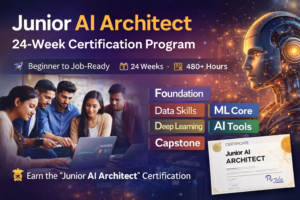
We are thrilled to announce something that has been months in the making — a course Junior AI Architect we believe will genuinely change career trajectories for a whole new generation of AI practitioners in India and beyond.
We are planning to launch a new 6-month course on “Junior AI Architect” — a structured, project-driven certification programme that takes you from zero programming experience to being genuinely job-ready in the field of Artificial Intelligence, Machine Learning, and Generative AI.
This is not a short YouTube playlist dressed up as a course. It is 24 weeks, 480+ hours of learning, six deep modules, two milestone assessments, and a capstone project evaluated by an industry panel. By the time you finish, you will have built real projects, published real code, and earned a certificate that means something — because the work behind it is real.
Let me walk you through everything.
🚀 Programme at a Glance
24
Weeks Duration
6
Deep Modules
20h
Per Week
480+
Total Hours
🎯 What You Will Learn in Junior AI Architect — And Who This Is For
This programme Junior AI Architect is designed for anyone who is starting from scratch. You do not need a computer science degree. You do not need prior programming experience. You need curiosity, commitment, and 20 hours a week. That is the honest entry requirement.
By the time you complete all six modules, you will be able to:
- Write Python from first principles all the way through to deploying real AI applications
- Clean, analyse, and visualise data using NumPy, Pandas, Matplotlib, and Seaborn
- Build, train, and evaluate machine learning models using Scikit-learn
- Implement neural networks in TensorFlow and PyTorch — including CNNs and NLP models
- Work with Generative AI, Large Language Models, and the OpenAI and Claude APIs
- Build and deploy a working AI web application using Streamlit
- Complete an end-to-end capstone project — from problem definition to live demo in front of an industry panel
What Graduates Walk Away With
| Outcome | Detail |
|---|---|
| 💼 Job-Ready Skills | Eligible for Junior AI/ML roles, data analyst positions, and AI developer internships immediately after graduation |
| 🏆 Certification | The “Junior AI Architect” certificate issued by Ryde Foundation, recognised by our partner organisations |
| 🚀 Portfolio of 6+ Projects | Real mini projects plus one capstone on GitHub — the kind of portfolio that gets hiring managers to respond |
| 🤝 Soft Skills | Technical writing, presentation, peer collaboration, Git workflow, and stakeholder communication — built throughout all 24 weeks |
| 🌟 Distinction Recognition | Top 10% of graduates receive a “With Distinction” endorsement for their LinkedIn profiles |
📍 The 6-Module Structure — Your 24-Week Roadmap
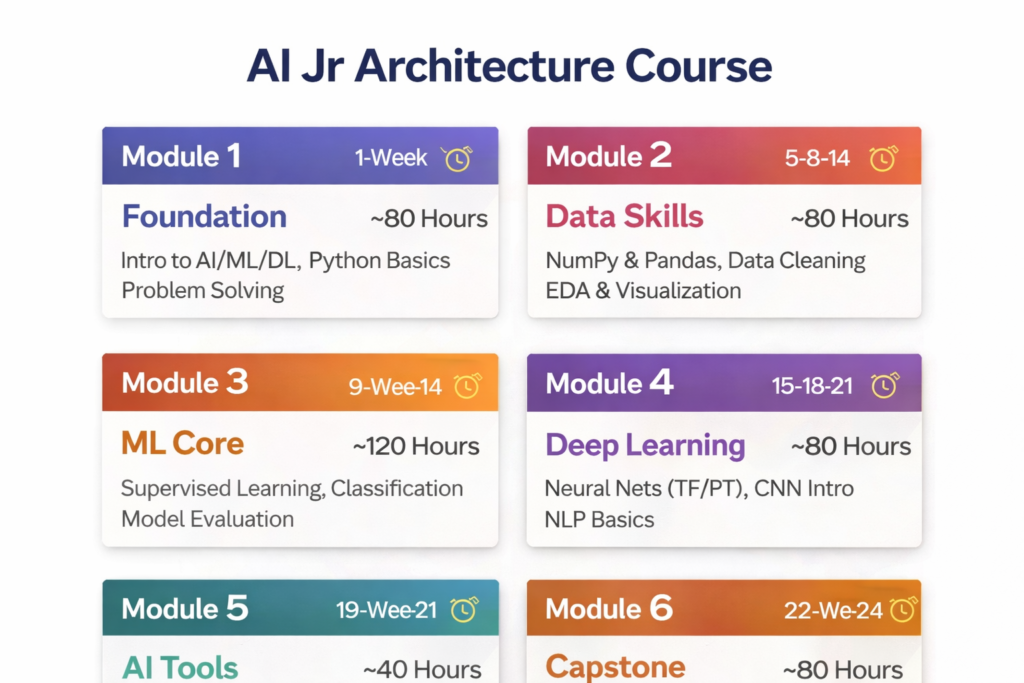
The programme runs in six sequential modules, each building on the last. You cannot skip ahead — the architecture of the course is intentional. Every module unlocks the next. Here is how the journey unfolds.
| Module | Weeks | Focus | Hours |
|---|---|---|---|
| Module 1 — Foundation | Weeks 1–4 | Python, AI concepts, problem solving, Git | ~80 hrs |
| Module 2 — Data Skills | Weeks 5–8 | NumPy, Pandas, data cleaning, EDA, visualisation | ~80 hrs |
| ★ Milestone 1 | After Week 8 | Python + data competency assessment (pass = 70/100) | — |
| Module 3 — ML Core | Weeks 9–14 | Supervised and unsupervised learning, model evaluation, Flask API | ~120 hrs |
| Module 4 — Deep Learning | Weeks 15–18 | Neural networks, TensorFlow, CNN, NLP, PyTorch | ~80 hrs |
| ★ Milestone 2 | After Week 18 | ML + Deep Learning competency assessment (pass = 70/100) | — |
| Module 5 — AI Tools | Weeks 19–21 | Generative AI, prompt engineering, OpenAI API, Streamlit | ~60 hrs |
| Module 6 — Capstone | Weeks 22–24 | End-to-end AI project: define → build → deploy → present | ~60 hrs |
🧱 Module 1 — Foundation (Weeks 1–4, ~80 Hours)
Every AI journey starts with Python, and every Python journey starts with the fundamentals. Module 1 does not rush. We spend four full weeks building the mental model and the coding habits that the rest of the programme depends on. If you do Module 1 properly, everything that follows feels logical rather than overwhelming.
Week 1 — Introduction to AI & Dev Setup
You start by understanding what AI, Machine Learning, and Deep Learning actually are — and how they differ. You set up Python, VS Code, and Jupyter Notebook, and you run your very first Python script and notebook. The mini project is called “Hello AI World”: a Python script that greets you by name and outputs three AI facts you have researched yourself. It goes to GitHub. From day one, you are building a portfolio.
Week 2 — Python Fundamentals I
Conditionals, loops, functions, data structures, file I/O, and exception handling. The mini project is a Student Grade Calculator — a program that reads scores from a file, computes averages, assigns letter grades, and prints a formatted report. By Week 2, you are already writing something genuinely useful.
Week 3 — Python Fundamentals II & OOP
Object-Oriented Programming: classes, objects, inheritance, encapsulation, modules, pip, and virtual environments. The mini project is a Library Book Manager — a command-line system using proper OOP design with file persistence. You are thinking like a software developer, not just a script writer.
Week 4 — Math, Git & Problem-Solving Mindset
Essential mathematics for AI — vectors, matrices, mean, median, standard deviation, and probability basics. Git workflow from init to push. Pseudocode and computational thinking. The mini project includes a Math Utilities Library pushed to GitHub, followed by a peer code review — your first experience of the collaborative professional workflow you will use in the real world.
📊 Module 2 — Data & Programming Skills (Weeks 5–8, ~80 Hours)
AI runs on data. Before you can build any model, you need to be able to handle, clean, and understand data. Module 2 turns you into someone who is genuinely comfortable with real, messy, incomplete datasets — because that is what the real world gives you.
Week 5 — NumPy & Array Computing
NumPy arrays, reshaping, slicing, broadcasting, linear algebra operations, and performance comparison against plain Python. Mini project: an Image Pixel Manipulator that loads a grayscale image as an array and applies brightness, flip, and crop operations using only NumPy. You will feel the power of vectorised computing firsthand.
Week 6 — Pandas for Data Analysis
Series, DataFrames, reading CSV/JSON/Excel files, filtering, groupby, merge/join, handling missing values. Mini project: Employee Dataset Analysis — a 500-row HR dataset where you compute department averages, find outliers, and summarise findings.
Week 7 — Data Cleaning & Preprocessing
IQR outlier detection, label and one-hot encoding, MinMaxScaler, StandardScaler, and full preprocessing pipelines. Mini project: a Real Estate Data Pipeline — you clean a genuinely messy housing dataset with missing values, outliers, and mixed data types, and produce a clean CSV ready for machine learning.
Week 8 — Exploratory Data Analysis & Visualisation
Descriptive statistics, Matplotlib and Seaborn, histograms, boxplots, scatter plots, correlation heatmaps, and the art of data storytelling. Mini project: a full EDA Report on the Titanic dataset — 5+ charts, 3 written insights, and a presentation to peers. By Week 8, you will communicate with data the way analysts do.
After Milestone 1, students who have consistently done the work feel a genuine shift in confidence. They stop thinking of themselves as “people learning to code” and start thinking of themselves as data practitioners.
— Jayanthan Solomon, Programme Director
★ Milestone Assessment 1 — After Week 8
Before you move to Machine Learning, you prove you are ready for it. Milestone 1 is a four-part assessment worth 100 points. You need 70 to pass.
| Part | Points | What It Tests |
|---|---|---|
| Part A — Python Coding Test (30 min) | 30 pts | 3 algorithmic problems using Python: OOP, file I/O, data structures. Graded on correctness and code quality. |
| Part B — Data Analysis Challenge (60 min) | 40 pts | Given a real dataset: clean it, perform EDA, and answer 5 data questions with visualisations. |
| Part C — Concept Quiz (20 min) | 20 pts | 20 multiple-choice questions: AI concepts, ML types, Python fundamentals, NumPy and Pandas. |
| Part D — Peer Collaboration Score | 10 pts | Assessed by peers on Git contributions, code review quality, and Week 4 pair exercise participation. |
Pass score: 70/100. Certificates emailed within 5 business days. One free retake available after a 1-week gap.
🤖 Module 3 — Machine Learning Core (Weeks 9–14, ~120 Hours)
This is the heart of the programme — and the longest module at 120 hours. By the end of Week 14, you will have implemented regression, classification, clustering, and unsupervised learning algorithms, tuned them with hyperparameter search, evaluated them rigorously, and even deployed one as a REST API. These are not toy exercises. They are the skills that appear in Junior ML engineer job descriptions.
Weeks 9–11 — Supervised Learning: Regression, Classification & Feature Engineering
- Week 9: Linear and logistic regression from scratch, then with Scikit-learn. Cost functions, gradient descent, confusion matrix, ROC curve. Mini project: House Price Predictor — tune hyperparameters, report R² and RMSE.
- Week 10: Decision Trees, Random Forests, K-Nearest Neighbours, and SVMs. Precision, recall, F1, cross-validation. Mini project: Spam Email Classifier — compare three classifiers with full metrics.
- Week 11: Feature creation, PCA, GridSearchCV, Scikit-learn Pipelines, and the bias-variance tradeoff. Mini project: Customer Churn Predictor — engineer 5+ features, tune a Random Forest to greater than 85% accuracy.
Weeks 12–14 — Unsupervised Learning, Model Evaluation & ML in Production
- Week 12: K-Means, DBSCAN, hierarchical clustering, Silhouette Score, t-SNE. Mini project: Customer Segmentation — cluster e-commerce customers by behaviour and recommend marketing strategies.
- Week 13: k-Fold cross-validation, AUC-ROC, learning curves, SHAP, data leakage detection, MLflow basics. Mini project: Model Evaluation Dashboard comparing five ML models.
- Week 14: Saving models with joblib/pickle, Flask REST API, model serving, technical writing. Mini project: Salary Prediction API — build, expose via Flask, write a 1-page technical brief, demo to class. Your first deployed model.
🧠 Module 4 — Deep Learning Basics (Weeks 15–18, ~80 Hours)
Deep Learning is where the magic of modern AI lives — and where most short courses give you a superficial overview and move on. We do not. You will implement a neural network from scratch using only NumPy, then build progressively more sophisticated models in TensorFlow and PyTorch, working on real computer vision and natural language tasks.
- Week 15 — Neural Networks Fundamentals: Perceptrons, MLP, backpropagation, activation functions. Mini project: XOR Classifier from Scratch — NumPy only. If you can build this, you genuinely understand how neural networks work.
- Week 16 — TensorFlow and Keras: Sequential API, Dropout, BatchNorm, EarlyStopping, TensorBoard. Mini project: Fashion MNIST Classifier achieving more than 90% accuracy.
- Week 17 — CNNs and Computer Vision: Convolutional layers, pooling, data augmentation, transfer learning with MobileNetV2, Grad-CAM. Mini project: Cats vs Dogs CNN with activation heatmap visualisation.
- Week 18 — NLP and PyTorch Basics: Tokenisation, TF-IDF, Word2Vec, embedding layers, LSTM, PyTorch tensors, autograd. Mini project: Sentiment Analyser on the IMDB dataset — more than 85% accuracy with full documentation.
★ Milestone Assessment 2 — After Week 18
| Part | Points | What It Tests |
|---|---|---|
| Part A — ML Model Build (90 min) | 35 pts | Given a new dataset: build, evaluate, and justify an ML model. Full Jupyter notebook with analysis. |
| Part B — Deep Learning Practical (60 min) | 35 pts | Implement a neural network in TensorFlow/Keras for classification. Achieve minimum benchmark accuracy. |
| Part C — Written Concept Exam (30 min) | 20 pts | 25 short-answer questions: ML algorithms, deep learning architecture, evaluation metrics, feature engineering. |
| Part D — Portfolio Review | 10 pts | Evaluator reviews Weeks 9–18 mini projects on GitHub: code quality, documentation, and progression. |
Pass score: 70/100. Students scoring below 70 receive a focused remediation plan before proceeding to Module 5.
⚡ Module 5 — AI Tools & Applications (Weeks 19–21, ~60 Hours)
This is where the programme connects everything you have built to the technology reshaping every industry right now — Generative AI, Large Language Models, Prompt Engineering, real APIs, and your first deployed AI application that anyone in the world can use.
- Week 19 — Generative AI and LLMs: Transformer architecture, attention mechanisms, GPT vs BERT, Hugging Face pipelines, AI ethics, bias, hallucinations, responsible AI frameworks. Mini project: LLM Explorer — run three Hugging Face models and write a comparative analysis.
- Week 20 — Prompt Engineering: Zero-shot, one-shot, few-shot techniques, Chain-of-Thought reasoning, role prompting, OpenAI and Claude API integration in Python, token limits, prompt templates. Mini project: Prompt Library for five business tasks with output quality comparison.
- Week 21 — Building and Deploying AI Apps: Streamlit layout and widgets, API key management, session state, deploying to Streamlit Cloud and Hugging Face Spaces, error handling, professional README documentation. Mini project: AI Assistant App — a domain-specific chatbot deployed to a live URL. Your first real product in the world.
🏆 Module 6 — Capstone Project (Weeks 22–24, ~60 Hours)
The capstone is not a test. It is a demonstration. You choose a real-world problem, build an AI solution from the ground up, deploy it as a working web application, and present it to a panel of evaluators. This is the project you will showcase to every future employer.
- Week 22 — Phase 1: Problem Definition and Planning. Choose a problem from healthcare, finance, education, or retail. Research the domain, identify datasets, define success metrics, create a project plan. Deliverable: 1-page Project Proposal.
- Week 23 — Phase 2: Build, Train and Evaluate. Collect and clean data, build and train your model, perform rigorous evaluation, and iterate at least three times. Deliverable: Technical Notebook pushed to GitHub.
- Week 24 — Phase 3: Deploy, Present and Certify. Deploy your model as a web application, deliver a 10-minute presentation with Q&A, write a 2-page project summary, submit all code and documentation. Evaluated by a 3-person panel: one instructor, one industry mentor, one peer. Deliverable: live demo app + GitHub repo + 2-page report.
Capstone Evaluation Rubric
| Criterion | Points | What Evaluators Look For |
|---|---|---|
| Problem Framing and Research | 15 | Clear problem statement, relevant dataset, well-defined metrics, solid domain research |
| Data Pipeline and EDA | 15 | Thorough preprocessing, insightful EDA, handled edge cases, clean reproducible pipeline |
| Model Selection and Training | 20 | Justified model choice, correct implementation, appropriate evaluation, at least 3 iterations |
| Deployment and Functionality | 15 | Working live app or API, clean UI, proper error handling, deployed to a public URL |
| Code Quality and Documentation | 10 | PEP-8 code, README, docstrings, GitHub commit history, reproducible setup |
| Presentation and Communication | 15 | Clear 10-minute demo, confident Q&A, explains technical concepts accessibly to non-technical judges |
| Innovation and Impact | 10 | Creative approach, real-world impact potential, going beyond minimum requirements |
| Total | 100 | Pass = 70+ | Distinction = 85+ | High Distinction = 95+ |
🛠️ Tools and Platforms — All Free, All Yours to Keep
One of the things we are most deliberate about in this programme is that every tool is free and openly accessible. We do not believe in locking learners into paid platforms. You can continue using everything you learn here long after the course ends, at zero cost.
| Category | Tools |
|---|---|
| 💻 Development | Python 3.x, VS Code, Jupyter Notebook, Google Colab (free GPU), Anaconda |
| 📊 Data and ML | NumPy, Pandas, Scikit-learn, Matplotlib, Seaborn, Kaggle Datasets, UCI ML Repository |
| 🧠 Deep Learning | TensorFlow 2.x, PyTorch, Keras, Hugging Face Transformers, TensorBoard |
| 🚀 AI and Deployment | OpenAI API (free tier), Anthropic Claude API, Streamlit, Hugging Face Spaces, GitHub |
| 📚 Free Learning Resources | fast.ai, Kaggle Learn, Google ML Crash Course, DeepLearning.AI, CS50 AI (Harvard), Andrew Ng on Coursera (audit free) |
🤝 Soft Skills Are Built In — Not Bolted On
One of the most common complaints from hiring managers in AI is that candidates can code but cannot communicate. They understand gradient descent but cannot explain it to a product manager. They build accurate models but cannot write a readable README. We take this seriously — soft skills are woven into every module from Week 1.
| Skill | When | How |
|---|---|---|
| 🗣 Communication | Weeks 4, 14, 21, 24 | Weekly “explain it simply” exercises. Present mini projects to peers. Final presentation to an industry panel. |
| 🤝 Collaboration | Weeks 4, 8, 22–24 | Pair programming in Week 4. Team-based EDA in Week 8. Capstone teams of 2–3 with shared GitHub repo. |
| 🧩 Problem Solving | Weeks 1, 4, 9–14 | Daily coding challenges on HackerRank. Case study discussions every Friday. Design thinking frameworks. |
| 📝 Technical Writing | Weeks 8, 13, 14, 24 | Write EDA summary reports. Document ML experiments. Produce a final 2-page project brief. |
| 🏗 Project Management | Weeks 22–24 | Agile-style sprint planning for capstone. Weekly standups. GitHub Projects or Trello for task tracking. |
| 🌐 Portfolio Building | All 24 weeks | Public GitHub portfolio built from Week 1. LinkedIn profile workshop in Week 20. Professional README templates provided. |
📅 Complete 24-Week Curriculum at a Glance
| Week | Module | Week Title | Key Topics | Mini Project |
|---|---|---|---|---|
| Wk 1 | M1 | Introduction to AI and Dev Setup | AI/ML/DL concepts, Python setup, Jupyter | Hello AI World |
| Wk 2 | M1 | Python Fundamentals I | Loops, functions, data types, file I/O | Grade Calculator |
| Wk 3 | M1 | Python Fundamentals II — OOP | Classes, modules, pip, venv | Library Manager (CLI) |
| Wk 4 | M1 | Math, Git and Problem Solving | Statistics, Git workflow, pseudocode | Peer Code Review |
| Wk 5 | M2 | NumPy and Array Computing | Arrays, broadcasting, linear algebra | Image Pixel Manipulator |
| Wk 6 | M2 | Pandas for Data Analysis | DataFrames, groupby, merge, missing values | HR Dataset Analysis |
| Wk 7 | M2 | Data Cleaning and Preprocessing | Encoding, scaling, pipelines | Real Estate Pipeline |
| Wk 8 | M2 | EDA and Visualisation | Matplotlib, Seaborn, correlation heatmaps | Titanic EDA Report |
| ★ Milestone Assessment 1 — Pass score: 70/100 | ||||
| Wk 9 | M3 | Regression and Classification | Linear/Logistic Regression, metrics | House Price Predictor |
| Wk 10 | M3 | Classification Algorithms | Decision Tree, RF, KNN, SVM | Spam Classifier |
| Wk 11 | M3 | Feature Engineering and Tuning | PCA, GridSearchCV, Pipelines | Customer Churn Predictor |
| Wk 12 | M3 | Unsupervised Learning | K-Means, DBSCAN, t-SNE | Customer Segmentation |
| Wk 13 | M3 | Model Evaluation | Cross-val, AUC-ROC, SHAP, data leakage | Model Evaluation Dashboard |
| Wk 14 | M3 | End-to-End ML + Flask API | Model serving, REST API, technical writing | Salary Prediction API |
| Wk 15 | M4 | Neural Networks Fundamentals | MLP, backpropagation, activations | XOR Classifier from Scratch |
| Wk 16 | M4 | TensorFlow and Keras | Sequential API, callbacks, TensorBoard | Fashion MNIST Classifier |
| Wk 17 | M4 | CNNs and Computer Vision | Conv2D, pooling, transfer learning | Cats vs Dogs CNN |
| Wk 18 | M4 | NLP and PyTorch Basics | Tokenisation, LSTM, embeddings, autograd | Sentiment Analyser |
| ★ Milestone Assessment 2 — Pass score: 70/100 | ||||
| Wk 19 | M5 | Generative AI and LLMs | GPT/BERT, Hugging Face, AI ethics | LLM Explorer |
| Wk 20 | M5 | Prompt Engineering | Zero/few-shot, CoT, API calls | Prompt Library |
| Wk 21 | M5 | Building AI Apps | Streamlit, deployment, documentation | AI Assistant App (Live URL) |
| Wk 22 | M6 | Capstone Phase 1 | Problem definition, dataset, planning | Project Proposal |
| Wk 23 | M6 | Capstone Phase 2 | Build, train, evaluate, iterate 3x minimum | Technical Notebook (GitHub) |
| Wk 24 | M6 | Capstone Phase 3 | Deploy, present, certify | Live Demo + Presentation + Report |
🏅 Certification and What Comes After
Every student who passes the capstone (70 or above) receives the Junior AI Architect certificate, issued by Ryde Foundation and signed by the Programme Director. This is not a participation certificate — it requires demonstrated competency across 24 weeks of genuine work.
- 🏆 Certificate of Completion — issued to all students who pass (70 or above) the capstone evaluation
- 🌟 With Distinction endorsement — awarded to the top 10% of graduates for their LinkedIn profiles
- 📁 GitHub Portfolio requirement — all six modules’ mini projects plus the capstone must be on public GitHub before certification
- 🤝 Evaluation panel — 3-person panel: one instructor, one industry mentor, and one peer from another team
📣 Register Your Interest
We are in the planning phase for the first cohort. We want to hear from people who are genuinely interested — students, career changers, professionals adding AI skills to their repertoire, or anyone who has been looking for a structured, serious programme to finally take the leap.
To register your interest or get notified when enrolment opens, reach out through the Ryde Foundation website at rydefoundation.in or connect directly on LinkedIn: linkedin.com/in/jayanthan-solomon-8782517.
This programme is going to change things for people who commit to it. I have designed it with that intention — and I look forward to seeing your name on the first cohort roster.
❓ Frequently Asked Questions
Do I need prior programming experience to join?
No. Module 1 starts from the absolute beginning — what AI is, how to install Python, and how to write your first line of code. You need no prior programming experience. You need curiosity and the commitment to invest approximately 20 hours per week for 24 weeks.
What is the time commitment per week?
Approximately 20 hours per week across 24 weeks — totalling 480+ hours. This is a serious programme designed to produce job-ready graduates, not a casual introduction. It works best for people who can dedicate focused, consistent time each week.
What does the programme cost?
Pricing for the first cohort has not been announced yet. Ryde Foundation’s mission is to make professional training accessible — affordability is a core design principle of this programme. Register your interest and we will notify you when enrolment details are confirmed.
What jobs can I apply for after completing this?
Graduates are eligible to apply for Junior ML Engineer positions, AI Developer roles, Data Analyst positions, and AI Developer internships. The combination of a public GitHub portfolio with 6+ real projects and the Junior AI Architect certificate gives you a genuine competitive advantage over candidates who only have certificates without demonstrable work.
Is this online or in-person?
The exact delivery format for the first cohort — online, hybrid, or in-person — will be confirmed when enrolment opens. The programme has been designed to work effectively in all formats. Register your interest to receive updates directly.
When does the first cohort start?
We are currently in the planning and registration-of-interest phase. The launch date will be announced through the Ryde Foundation website and LinkedIn. Connect with Jayanthan Solomon on LinkedIn to be among the first to know.
Related content on Ryde Values:
- The Last 20 Years of Artificial Intelligence — Evolution and Innovation
- Best AI Tools 2026 — Top-Rated Artificial Intelligence Software
- Ultimate Guide to AI Writing and Productivity Tools
Junior AI Architect is a certification programme offered by Ryde Foundation. Programme Director: Jayanthan Solomon. For information visit rydefoundation.in or connect at linkedin.com/in/jayanthan-solomon-8782517. Programme structure, dates, fees, and cohort details are subject to finalisation. © Ryde Foundation 2026.


Leave a Reply
You must be logged in to post a comment.