What is Artificial Intelligence?
Artificial Intelligence (AI) refers to computer systems designed to simulate human intelligence. These systems can learn from data, recognize patterns, make decisions, and generate content with minimal human intervention.
In simple terms:
AI enables machines to think, learn, and act like humans—faster and at scale.
Why AI Matters Today
AI is no longer futuristic—it is already embedded in daily life and workplaces.
- Automates repetitive tasks
- Improves decision-making using data
- Enhances productivity and efficiency
- Enables new business models and services
- Reduces manual effort and operational costs
Therefore, AI skills are becoming essential across industries.
Key Types of AI
Narrow AI (Weak AI)
Narrow AI is designed to perform specific tasks efficiently. It focuses on a single function or problem area.
Examples include ChatGPT, voice assistants, and recommendation systems used on digital platforms.
General AI (Strong AI)
General AI represents human-level intelligence across multiple tasks. It can understand, learn, and apply knowledge broadly.
Currently, General AI remains theoretical and has not yet been achieved.
Core AI Technologies (Simplified)
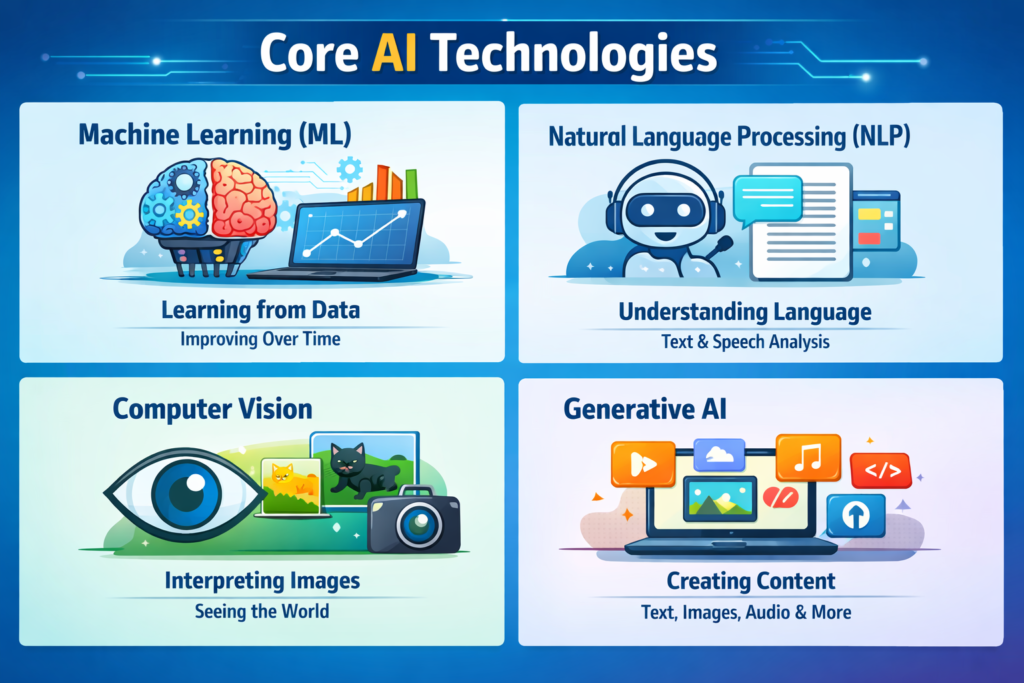
- Machine Learning (ML) – Systems learn from data and improve over time
- Natural Language Processing (NLP) – Understanding and generating human language
- Computer Vision – Interpreting images and videos
- Generative AI – Creating text, images, videos, audio, and code
Popular AI Tools (Examples for Training)
- ChatGPT – Content creation, Q&A, automation
- Microsoft 365 Copilot – AI inside Word, Excel, Outlook, PowerPoint
- AI Image & Video Tools – Text-to-image and text-to-video creation
- AI Automation Platforms – Workflow and office automation
Real-World Applications of AI
- Business & Office Automation
- Marketing & Content Creation
- Education & Training
- Travel Planning
- Healthcare & Finance
- Customer Support (Chatbots)
In fact, AI can enhance almost every job role, not replace it.
Benefits of AI Adoption
- Faster task completion
- Improved accuracy
- Better insights from data
- Scalable solutions
- Enhanced creativity
Challenges & Responsible AI
- Data privacy and security
- Bias in AI models
- Over-dependence on automation
- Ethical and legal considerations
Hence, responsible and ethical AI usage is critical.
The Future of AI
AI will continue to evolve toward smarter assistants, personalized experiences, and seamless human-AI collaboration.
Finally, the goal of AI is not to replace humans, but to augment human capabilities.
Suggested Training Transition Line
“Now that we understand what AI is and why it matters, let’s explore how we can use AI tools practically in our daily work.”
Visit our other AI Blogs
Make – Advanced Office Automation Platform
Ultimate Zapier AI Guide: Automate Your Work
Microsoft 365 Copilot: AI Assistant for Modern Work
Visit our Ryde Foundation Site